













“Formula 1 ok…It’s soooo predictable, the fast car always wins…I can’t believe the FAST CAR beat the SLOW CAR…68 Laps?!?!?!?”
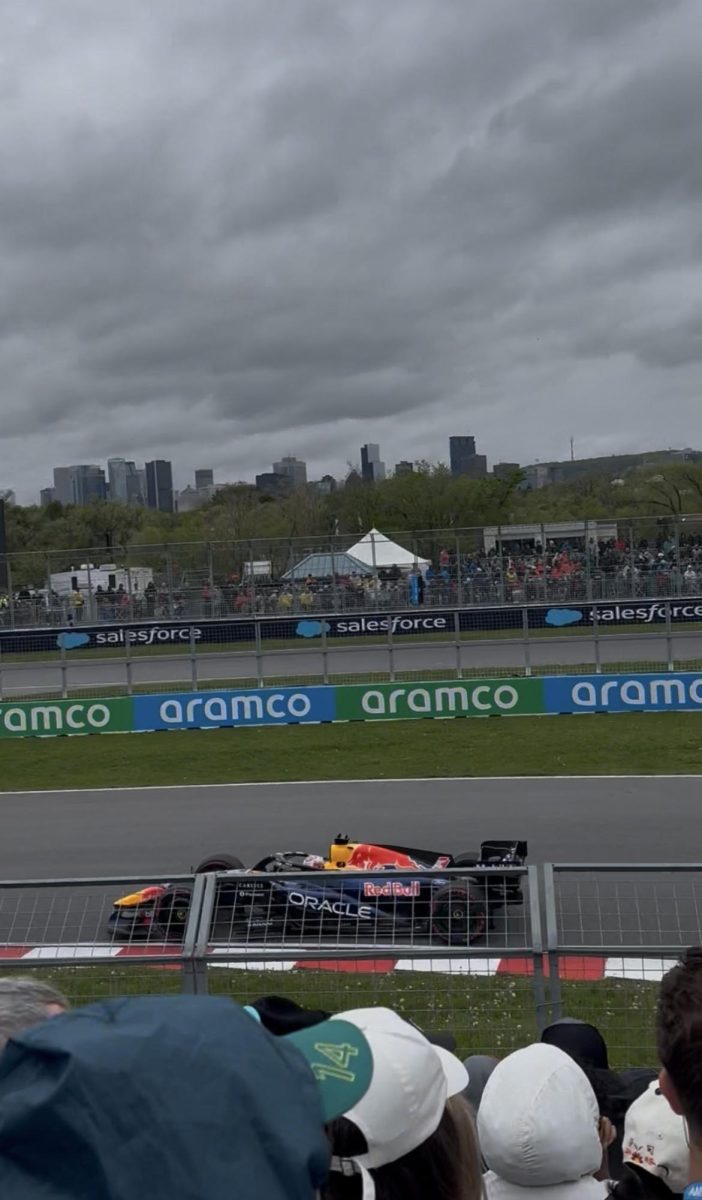
Have you heard this line of reasoning before? I have – the brilliant argument loudly and proudly punching my left ear drum, courtesy of a distant family member sitting to my left at the Montreal Grand Prix this past weekend. “No” I reply, “It’s not that simple” – but really, who am I kidding? It is that simple. But it’s also not that simple at all. Well – anyway:
Many such conversations have been had about Formula 1, and the tribunes are not without the individuals oh-so-happy to point out that the fast car, often…well, very often, beats the slow car.
As much as I hate to say it, these people are on to something, but they are also not, as I was reminded by the events that ensued at the glorious Gilles Villeneuve Grand Prix in Montreal.
Maneuvering between Heineken stands, driver cut-outs, and avid betters, I was struck by the sheer number of similarly-dressed fans that had gathered for the race – especially by those forming the long line for the trash-sorting championship. I was also thinking about some of F1’s recent updates:
For one, I was excited to see a race without the Drag Reduction System (DRS) in person.
Installed in 2011 to help drivers overtake by reducing aerodynamic drag – air resistance opposing motion – while increasing straight-line speed, DRS was a movable rear-wing flap that could be used to overtake other cars in designated “DRS zones” on the track.
Aside from being in a designated zone – usually a high-speed straight – an ambitious driver also had to be within one second of the car ahead to even dream of an overtake. Furthermore, the system was not without controversy: critics have long argued that DRS made overtaking too easy or difficult depending on the circuit.
After 14 seasons, the critics have prevailed: DRS was entirely removed for the 2026 season, replaced with a new active aerodynamic system by the FIA(the international governing body for motor-racing events).
This system – available to every driver on EVERY lap – now controls both the front and rear wings simultaneously, and has signaled a dramatic shift from a single, limited tool to a continuous source for overtakes. Consequently, races have become closer and more high-stakes – drivers can now take their chances in rainy conditions and EVEN during the first two laps. That being said, I was excited to see how the new systems would play out on the high-speed straights of the Montreal circuit: the Circuit Gilles Villeneuve.
Passing by a screen featuring Kimi Antonelli’s interview and screaming fans, I also began thinking about the 19-year-old’s three consecutive Grand Prix wins (China, Japan, Miami) despite some notable slow starts, and wondering whether Russell and Antonelli would be a repeat of last year’s epic battle between Piastri and Norris (and Verstappen). With Antonelli’s wins, Verstappen’s feats, and Russell’s sprint race win of the previous day fresh in mind, I knew the race would be tight. Nevertheless, I did not anticipate the emotional turmoil that was to come.
Sitting in the tribune close to the northern “hairpin turn”, I got to stand and applaud every time the Mercedes cars whirred by – hailing the thirty-lap long fight for first place between Russell and Antonelli. The zest of an F1 crowd standing for every overtake is unmatched, and the show that was the first half of the race fired up everyone. It seemed the battle would continue right up to the finish line, at least until Russell – in first position and therefore priority for the first pit stop – experienced a mechanical failure. Jubilant at Antonelli’s advance and distraught at the reigning champion’s sudden failure, a silence settled over the crowd.
Fortunately, an F1 crowd can’t stay silent for long, and soon everyone was up on their feet again, watching drama unfold between Hadjar and Leclerc – and later Verstappen and Hamilton. Overall, the race was a far cry from uneventful, and I got to prove my distant family member wrong:
If the fast car always beats the slow car, how come McLaren – the team with the third-best result in the 2026 F1 Constructors’ Championship – finished the race with a gearbox failure for Norris and 11th place for Piastri, 2 whole laps behind Alpine(fifth), Racing Bulls(sixth), Haas(seventh), and Williams(eighth)?
Not to mention, how could Mercedes – the team with the best car – end with a power unit failure for George Russell, the winner of the previous sprint race and a top contender for the winner of the Drivers’ Championship? To top it all off, Max Verstappen hasn’t even been mentioned yet, and he makes the fast – to – slow car distinction seem like a purely arbitrary thought.
All in all, F1 is clearly more nuanced than “the fast car beats the slow car”
That being said, a fast car can still make or break a top-tier team. For those preferring to hone in on that fact, F2 is a great alternative. Blood-thirsty drivers vying for first place in identical cars makes for an entertaining race full of crashes – the Formula Molotov cocktail.