










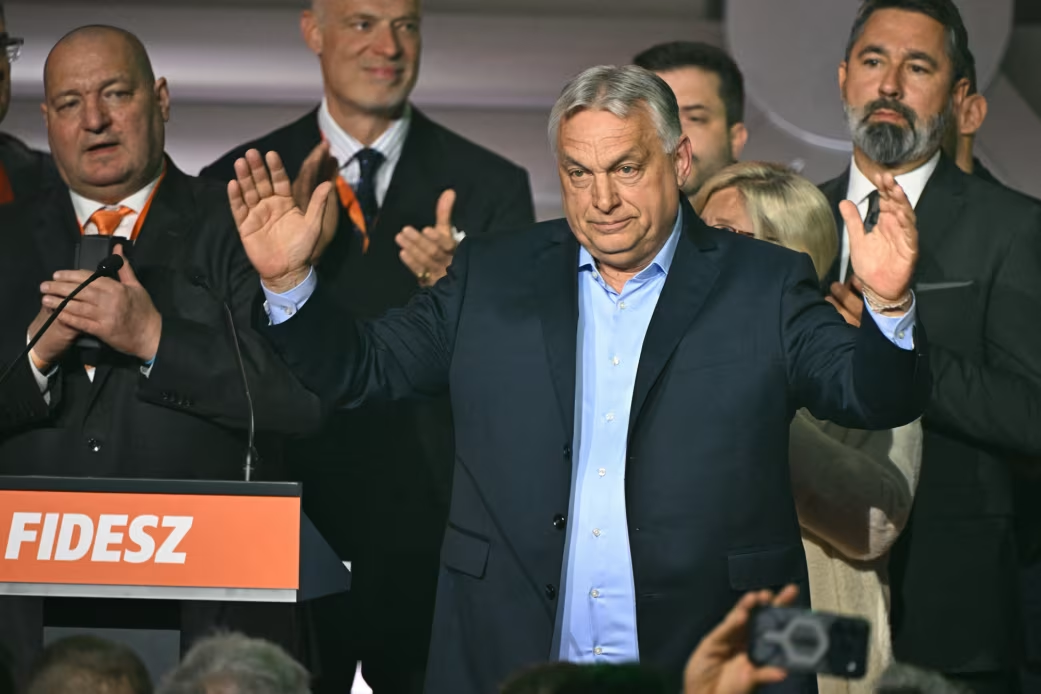




Hungarian Prime Minister Viktor Orbán has lost reelection after 16 years of power across two separate stints, with the loss being deemed, “a great sign for democracy” by one Clinton student who has wished to remain anonymous. Known for running an “illiberal democracy,” Orbán has managed to maintain a tight grip on the country’s media and has been accused of both keeping the press under his thumb and suppressing independent journalism critical of him and the ruling Fidesz party. His ideology has predominantly aligned with right-wing populism, which has been on the rise in recent years, with the re-election of President Trump in 2024, and with many in the UK seriously considering electing Nigel Farage — the leader of prominent right-wing party Reform UK (formerly known as the Brexit Party) — in the country’s next General Election. However, the tide appears to be turning throughout the world. In addition to Orbán’s defeat in Hungary, the Republican Party in the US is largely expected to lose this year’s midterm elections, with some Congressional seats in red states being flipped to the Democratic Party. Right-wing populism shares common features in many countries.
A prominent populist movement is usually birthed from the frustration with current leadership and a lack of actual change. Many right-wing populists have managed to exploit this dissatisfaction, including Donald Trump. Growing discontent with incumbent President Biden – as well as with his economic policies – helped strengthen Trump’s platform, leading many voters to side with him in the most recent US Presidential Election under a common belief: that there was greater economic growth without the leadership of President Biden. A surge of inflation during the election season didn’t help the Democratic platform either.
In the United Kingdom, many now consider Nigel Farage as more than a nutter due to Prime Minister Keir Starmer’s Labour government facing widespread accusations of two-tiered policing throughout the country and a lack of proper immigration enforcement. In Canada, up until the resignation of Prime Minister Justin Trudeau, many were considering Pierre Polievre – the leader of the Conservative Party – as a viable option due to common frustration with the inflation and lack of GDP growth experienced during Trudeau’s 12 year premiership.
Right-wing populists also gain support by demonizing opponents as fundamentally harmful to the good of the people. President Trump – no stranger to this tactic – has used many nicknames to describe President Biden, including Autopen, Sleepy Joe, and Crooked Joe. These nicknames reflect criticism based on his age and use of an autopen for pardons, something many presidents have done in the past. Through the use of these nicknames, President Trump is able to create his own version of President Biden and project it to his base of support. This is how right-wing populists such as Orbán maintain a tight control of a country’s news media: by projecting their versions of opponents to improve their own image. In an attempt to do the same, President Trump has been actively targeting news outlets such as CBS and the BBC whilst praising right-wing outlets such as Fox News or OANN. In the UK, Nigel Farage has previously stated that he would like to see GB News, a prominent right-wing news outlet, replace the centrist BBC as the UK’s state broadcaster.
This phenomenon is a crucial aspect of another feature of right-wing populism: the erosion of civil liberties within the country to maintain an illiberal democracy. This is primarily done through the aforementioned control of a country’s news media, along with other authoritarian actions. For example, per the Alien and Enemies Act of 1798, President Trump has the power to place many in the United States into a process known as expedited removal, which is the forceful deportation of one from the country without due process. Many in the country believe that this is a clear violation of the 5th Amendment of the United States Constitution, and yet it is still a regular occurrence in the United States. Another example is Nigel Farage’s wish to have the United Kingdom leave the European Court of Human Rights within the first minute of his premiership. This will allow for certain methods of mass deportation to be implemented in the United Kingdom to meet Farage’s goals of limited migration, despite such methods being considered violations of one’s basic human rights by much of Europe.
All in all, with this recent defeat in one of Europe’s most prominent illiberal democracies, right-wing populism appears to be currently in decline across the world. But as one has seen in the United States across Biden’s presidency, right-wing populism can seem to be over with the election of more moderate leaders – seemingly dormant for four years – only for it to resurface, and take back power — all because one did not do enough to stop it from subduing the freedoms one is given at birth, as it has done across the world throughout history. It will continue to do so unless enough people can see it for what it truly is: a scam, a lie, and a con, promising everything, and giving almost nothing to the citizens of the world in return for the votes it received – pushing agendas that are doomed from their very inception through means that erode one’s civil liberties. It can only be stopped when its cloak of invisibility is unveiled to the world. Until then, the true fall of right-wing populism has yet to come.